
By Aidan Grogan
When I began college as an undergraduate student in the fall of 2016, I had no intention of ever getting involved in politics, nor did I yet have any passionate or well-informed political views. But a contentious presidential election was only a couple months away, and American college campuses had recently become thoroughly saturated with a radical, anti-American ideology, which has since become popularly known as “wokeness.”
America’s bastions of higher learning, where diverse perspectives are meant to be freely exchanged and challenged in the pursuit of truth, had become vapid echo chambers of intellectual uniformity. Campuses were dominated and policed by “social justice warriors,” “microaggressions,” “trigger warnings,” “safe spaces,” and humdrum appeals to “Diversity, Equity, and Inclusion.”
The gray-haired sixties radicals had infused university curricula with the ideological anthrax of Critical Theory and used their professorships as pulpits of progressive orthodoxy. Any humanities or social science courses I enrolled in “deconstructed” and castigated everything I loved but took for granted: freedom of speech, free-market capitalism, the nuclear family, Western civilization, and the Christian faith.
I attended Columbia College Chicago to study music production but, engulfed by the political riptides that surrounded me, quickly changed my major to journalism and began writing about current events and the most pressing issues of our time. However, I was alone in the divergent views that I subscribed to, which I came to understand as conservatism. My liberal arts college classmates either burned with rage against individual liberty and free markets, or they blindly nodded along with the progressive platitudes and virtue signals.
And so, I sat in silence through every lecture as my professors spewed their biases and my classmates diligently took notes. A history professor drew the right-left political spectrum on the whiteboard, circled Marxism, and said to the class: “This is where we need to be, but people don’t like change.” Or they don’t like gulags, I thought.
“Charlie Kirk and Turning Point USA convinced me that there is more risk in the act of not speaking than in the act of speaking.”
Like many young conservative students, I was hesitant to express a contrary viewpoint aloud, as I didn’t want my grades or my reputation to be harmed, let alone to be personally harassed, threatened, or even assaulted. Yet I knew that there was an organized movement out there, somewhere, that provided young conservatives with a platform and opportunities to network with freedom-minded students and collectively push back against left-wing hegemony. Unfortunately, there was no Turning Point USA chapter on my campus. The brief Young Americans for Liberty chapter that existed disbanded due to a lack of interest and participation.
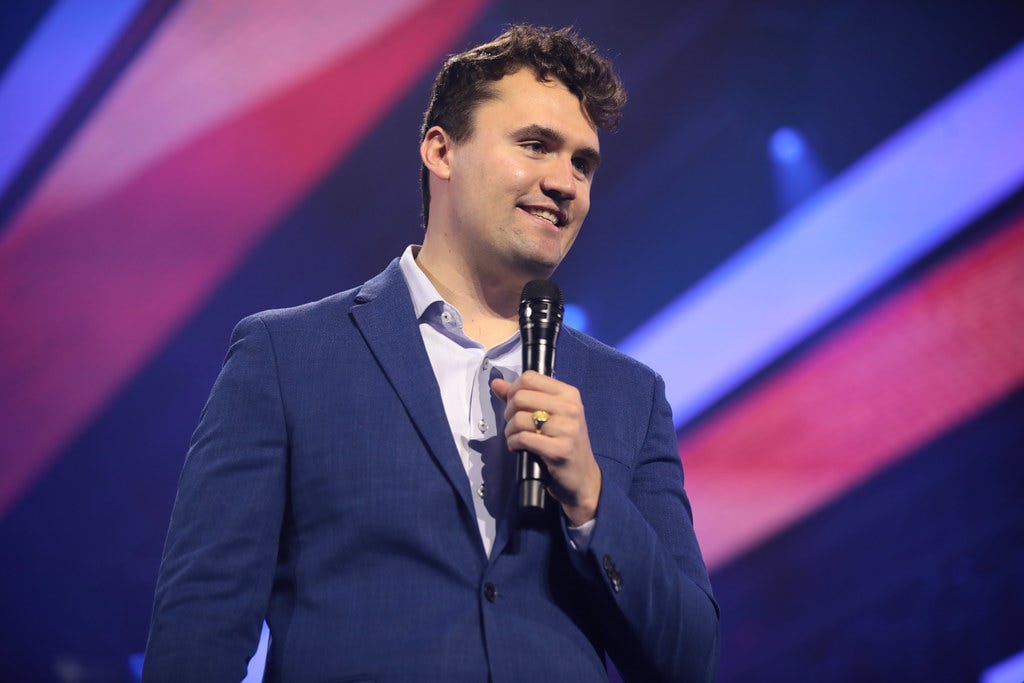
While deprived of any close intellectual allies, I was inspired by the grit and unrelenting courage of Charlie Kirk, a Chicago suburban native like myself who stood unabashedly against the left-wing mob and boldly championed the ideas of freedom. Charlie Kirk and Turning Point USA convinced me that there is more risk in the act of not speaking than in the act of speaking.
The movement Charlie Kirk spearheaded ignited my enthusiasm and confidence to speak out during classes and dispute not only my professors’ beliefs, but also the course curricula, regardless of what opposition I would face. And to my astonishment, every time I debated a professor, or even dozens of students at once, someone always reached out to me in private and revealed that they agreed with me.
When I transferred to Illinois State University (to escape the liberal arts college indoctrination), I became active in Turning Point USA and served as president of Illinois State’s Young Americans for Liberty chapter. It was evident that Charlie Kirk’s movement was growing, with professors and students alike recognizing the Turning Point USA brand, although not without frequent belligerence. A conservative student was head-locked and wrestled to the ground, unprovoked, by a sociology professor while peacefully hanging up Turning Point USA posters.
Campus politics during my undergraduate years — 2016-2020, when institutionalized “wokeness” kicked into high gear — was energetic and exciting, but also deeply Orwellian and terrifying. Zoomers, unlike previous generations, encountered an entirely different campus culture, where dissident viewpoints were routed out, silenced, and crushed.
But Charlie Kirk led a formidable pushback against the dystopian intellectual conformity on campuses and scored impressive victories in the battle for the hearts and minds of America’s youth. College-aged American adults, both male and female (ages 18-24), are now more conservative than liberal. In the past few years, Charlie Kirk became a household name, convincing millions of high school and college students to cherish and defend traditional American values
“Charlie Kirk may have been ruthlessly and cowardly silenced, but the message he valiantly communicated to millions of Americans is bulletproof.”
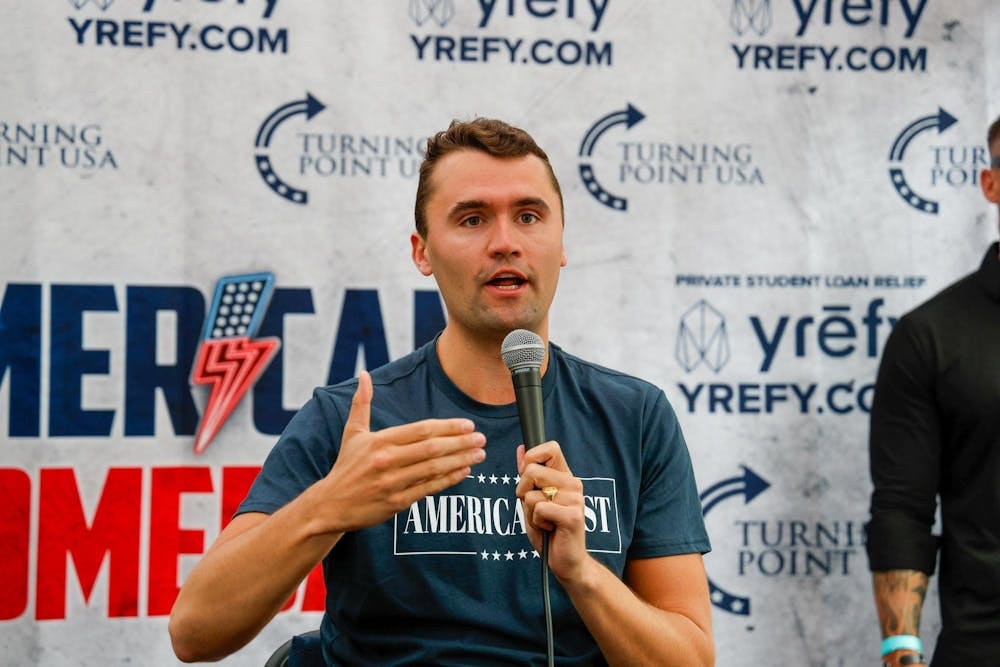
At every stop on his 2025 “The American Comeback Tour,” Charlie Kirk drew massive crowds, including both conservatives and liberals, who were familiar with Turning Point USA and eager to discuss and debate ideas. I was delighted that he hosted one such event at my alma mater, Illinois State University, which was attended by hundreds of students, many of whom were friendly and politically aligned with him. Nothing like this would have been possible when I was a student there just five years ago.
As I reflect on nearly a decade of involvement in conservative circles, I realize I owe a tremendous debt of gratitude to Charlie Kirk. My activism with Turning Point USA opened up a whole new world to me — the broader ecosystem of center-right nonprofits — which many young, right-leaning Americans still don’t even know exists. Organizations like the Leadership Institute, Campus Reform, Young America’s Foundation, Young Americans for Liberty, and, of course, Turning Point USA are gateways into the established conservative movement — for those with the curiosity and determination to get involved.
Through these campus organizations, one discovers websites like Conservative Jobs and Talent Market, which list job openings at legacy center-right think tanks such as the Heritage Foundation, the American Enterprise Institute, the Intercollegiate Studies Institute, and the Acton Institute.
It was also through this movement that I learned about Liberty University, which I have attended since 2021 as both an English master’s student and a history PhD student. Charlie Kirk was scheduled to speak at Liberty’s 2025 Fall Convocation on October 24, but his life was unexpectedly cut short by an assassin during an event at Utah Valley University.
In the 1950s, William F. Buckley, Jr., disgruntled by left-wing biases at Yale, inaugurated the post-war American conservative movement by founding National Review. He later co-authored the “Sharon Statement,” which served as guiding principles for conservatism and the founding document of Young Americans for Freedom, today known as Young America’s Foundation.
While there have always been competing factions on the institutional Right, Charlie Kirk inherited the mantle of leadership in the conservative movement and, as its foremost articulator, introduced a new generation to the timeless principles of liberty. No movement like this exists in other countries. Its message and momentum have become so powerful and unstoppable that, tragically, its opponents are resorting to political violence, because they can’t defeat it with civility in the marketplace of ideas. Charlie Kirk may have been ruthlessly and cowardly silenced, but the message he valiantly communicated to millions of Americans is bulletproof.
This is a solemn moment for those on the Right, despite their many disagreements over trade, foreign policy, and immigration, to recognize that we all stand for freedom — and Charlie Kirk was a brave crusader for our cause.
It is up to us, and those who follow, to carry that torch forward and secure a free, prosperous future for ourselves and our posterity.
May God rest the soul of Charlie Kirk, in everlasting peace.
Aidan Grogan is a history PhD candidate at Liberty University and a Young Voices contributor. His work has been published in National Review, The Daily Wire, The Federalist, The American Spectator and RealClearMarkets. Follow him on X @AidanGrogan.
I would suggest revising this line in light of more recent information about the shooter:
"Its message and momentum have become so powerful and unstoppable that, tragically, its opponents are resorting to political violence, because they can’t defeat it with civility in the marketplace of ideas."
Framing the event this way irresponsibly inflames tensions and oversimplifies a still-developing situation. Escalating the temperature of the conversation in this manner is fundamentally at odds with the very principle of civic discourse that you identify as a core American value worth protecting.