
Liberty Needs Influencers
How the Structure of Social Change has shifted the Internet Era


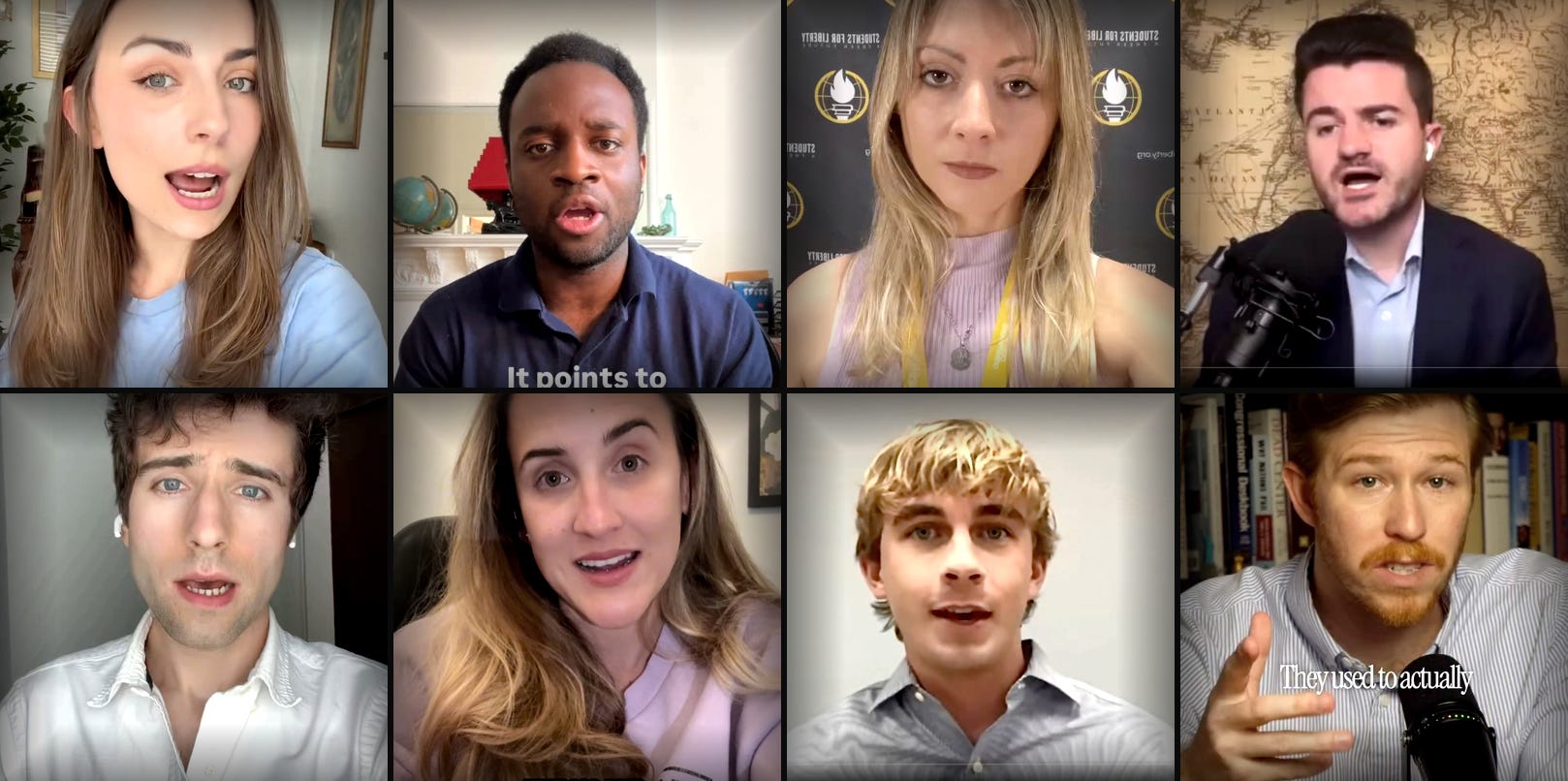
The classical liberal movement is operating on an outdated model of social change that needs a 21st-century update.
For decades, libertarian and freedom-conservative nonprofits have heavily invested in the production of ideas with the assumption that pro-liberty values will trickle down to shape public opinion and change laws. With the advent of the internet and declining public trust in institutions, the liberty movement must now evolve by investing not only in institutions, but in influencers who can carry classical liberal thinking into the digital age.
Mercatus Center founder Richard Fink famously taxonomized the modern public policy infrastructure in his 1996 essay “The Structure of Social Change.” Drawing on Friedrich Hayek’s structure of production, Fink argued that three institutions played distinct but equally important roles in changing law: universities, think tanks, and activist groups.
Universities produce the “intellectual raw materials” of scholarship and theory. Think tanks then translate those ideas into policy solutions for real-world problems. Finally, activist organizations convert those policy ideas into campaigns citizens can understand and rally around.
This model worked remarkably well in the 20th century. Academics such as Milton Friedman helped end the draft, Ronald Coase shaped spectrum deregulation, and Art Laffer influenced the Reagan tax cuts. Think tanks helped drive airline and trucking deregulation in the 1970s. Litigation groups such as Institute for Justice, Foundation for Individual Rights and Expression (FIRE), Pacific Legal Foundation, and others have secured major victories for free speech, economic liberty, and constitutional government.
In the digital age, however, social change requires another link in the chain: content creators.
At first blush, the notion of investing in influencers may seem shallow. Public policy, after all, is serious business, and many influencers monetize themselves by being very unserious people. But institutional trust is collapsing across American life, especially among younger generations. The latest edition of Harvard’s Youth Poll found that only 13% of Americans ages 18 to 29 believe the country is headed in the right direction.
At the same time, the public square has shifted away from institutional media toward individual personalities. Fox News averages only a few million primetime viewers each night, while social media platforms now dominate how Americans consume information. According to Pew Research, 84% of Americans use YouTube, 71% use Facebook, and 50% use Instagram.
The nationalist right has understood this shift better than libertarians have. Independent personalities like Tucker Carlson have shown how creators can shape elite conversations outside traditional institutions. But classical liberals should not outsource anti-establishment energy to illiberal figures who occasionally align with us by happenstance. We must build our own ecosystem of communicators who can persuasively articulate the values of a free society in the language of the internet age.
In many ways, this is not a revolutionary idea, but rather a 21st-century evolution of Hayek’s understanding of how ideology influences society.
In his landmark essay “The Intellectuals and Socialism,” Hayek argued that socialism spread not because workers independently arrived at socialist conclusions, but because intellectuals and cultural intermediaries popularized those ideas for the broader public. Journalists, teachers, writers, artists, broadcasters, and commentators became what Hayek called “secondhand dealers of ideas.”
Today, those secondhand dealers increasingly operate through podcasts, YouTube channels, newsletters, livestreams, video shorts, and social media platforms. The liberty movement needs far more people occupying those spaces.
This does not diminish the importance of universities, think tanks, or activist organizations. Those institutions remain essential. But classical liberalism cannot thrive in the digital age without a much larger ecosystem of independent creators translating the principles of freedom into persuasive, culturally relevant content for mass audiences.
Some organizations are already beginning to recognize this shift. At Young Voices, our work over the coming years will increasingly focus on helping communicators build audiences and platforms independent of traditional gatekeepers. We are strategically recruiting content creators into our programs and bringing staff onboard to build paths for pro-liberty creators to make a full-time living exploring the ideas that make free societies flourish.
But much more is needed.
Classical liberal ideas must be passed down to every new generation to survive. That task can no longer rest solely with universities, think tanks, magazines, and policy shops. The freedom movement must build a new generation of secondhand dealers of ideas for the digital age — creators capable of reaching millions of people where they actually are.
The future of Western civilization may depend on whether we do.
 | A guest post by
|